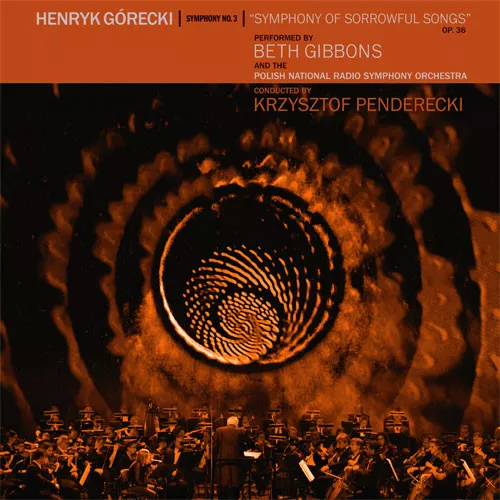
Live 2014 Performance On 180g Vinyl LP!
Domino is extremely proud to present Henryk Górecki: Symphony No. 3 (Symphony ofSorrowful Songs) performed by Beth Gibbons and the Polish National RadioSymphony Orchestra, conducted by Krzysztof Penderecki. The performance tookplace at The National Opera Grand Theater in Warsaw on November 29, 2014, andwas part of an evening of programming that also featured Jonny Greenwood’s (Radiohead)48 Responses To Polymorphia and the world premiere of Bryce Dessner’s (TheNational) Réponse Lutoslawski.
Following an invitation to collaborate at the concert, Beth Gibbons undertook anintense preparation process, including tackling the challenge of learning theoriginal text (and the emotional weight it carries) without speaking the motherlanguage. Typical to Beth though – the elusive yet iconic front-woman of one ofthe most important British bands (Portishead) of the last two decades – thechallenge was met and exceeded. Her performance alongside the maestro KrzysztofPenderecki has been hailed as triumphant, as you can see and hear on thisrelease.
“It began in 2013 in Kraków.
Portishead, the band Beth has fronted for nearly 25 years, was playing at theSacrum Profanum festival in the reclaimed steelworks in Nowa Huta: a giant,forbidding industrial complex on the outskirts of one of Europes most beautifuland contradictory cities.
“Between soundcheck and gig, Filip Berkowicz, the promoter, casually suggestedthat Beth could sing Henryk Góreckis third symphony, the Symphony Of SorrowfulSongs (Symfonia piesni zalosnych). The seed was sown.
“Beth struggles to stay still, which steers her toward the unexpected. When itcomes to promoting records, she has withdrawn from interviews, where she feelsawkward. When making an album away from Portishead, she teamed up with PaulWebb, late of Talk Talk, and turned out a series of beguiling songs (Out OfSeason). When the world expected a new Portishead album, Beth scored two Frencharthouse films (Diane Bertrands LAnnulaire and Baby Blues) instead.
“Beth neither speaks Polish nor reads music. But in preparation for theperformance, she worked from an especially prepared vocal score bearing theoriginal text, a phonetic interpretation, and crucially – a translation.
“It was central to the performance that Beth could find her way. She tried andre-tried different interpretations of the piece, not wanting just anotherrendition.
“The other challenge was the music itself. Beths voice is, in classical terms,a contralto; Górecki wrote for a soprano, one register higher. While she hadventured into the soprano range before the chorus of All Mine, fromPortisheads second album, for instance she hadnt spent a sustained stretchof time there in performance. So she had vocal coaching from CarolineJaya-Ratnam in England, then Anna Marchwinska from Poland, with whom she alsorefined the pronunciation.
“But Beths guiding principle, into which she packed all the technicalities ofperformance and language and character, was to engage emotionally with thepiece.
Is technique more important or is the effect on the heart more important?”
“Whether singing one of her own lyrics Who am I? What? And why? or one ofthe symphonys Kajze mi sie podziol mòj synocek mily? (Where has he gone,my dearest son?) she is aiming at a direct emotional injection from performerto audience. In the voices of the symphonys text, as in life, she is a motherand daughter.
“Rehearsals took place in the NOSPR in Katowice, under the direction ofKrzysztof Penderecki. Beth brought on board another long-term collaborator,artist John Minton, to prepare a visual backdrop to the performance a seriesof focal points: a wall of lichens; an endless corridor; the undulating flame ofa candle.
“On 29th November 2014, all the detailed and difficult work came to itsconclusion at the National Opera Grand Theatre in Warsaw. The apparentsimplicity of Góreckis third symphony its straightforward harmonies andrhythmic regularity is belied by the score; this is not an easy piece for anyof the performers.
“Dynamic changes happen over vast stretches of time; canons build andinterweave; there are sustained stretches in which singer and orchestra have tokeep the music hovering, almost still the same effect you witness when a birdcoasts alongside a boat at the same speed: everything is moving but seemsmotionless. And the texts themselves bear the same contradictions simplelanguage and exposed sentiments, beneath which are pain, loss, tragedy andhorror.
“At the end of the performance, there was as always happens with this piece a ghostly, shattered silence in which the whole room decompressed.
“Then the applause, rolling into a standing ovation. One critic wrote of Bethsmusicality, authenticity and simplicity another of her sincerity anddirectness she knew what she was singing about.
“Authenticity; directness; simplicity all pleasing effects; none achievedwithout total commitment and engagement. She sang in her own way, read onereview. Beths way is often the long way; corners arent cut. Pablo Casals wasonce asked why, at the age of ninety and widely regarded as the finest cellistin the world, he was still practising every day. Because, he said, I thinkIm making progress.
“The concert, given by the Polish National Radio Symphony orchestra underKrzysztof Penderecki, opened with the conductors own Polymorphia (1961), aradical piece of string writing for which the composer had to devise his ownnotation. Jonny Greenwoods witty 48 Responses to Polymorphia (2011) followed,with the 48 string players all echoing some of the percussive effects ofPolymorphia by doubling on pacay bean shakers. Next came Witold LutoslawskisMuzyka zalobna (1958), a twelve-tone composition dedicated to Bela Bartók,before the first half concluded with the world premiére of Bryce DessnersRéponse Lutoslawski (2014), the first explicitly tonal piece of the evening,full of nods not only to Lutoslawski but also to minimalism. Góreckis SymphonyNo.3 occupied the whole second half of the evening.
“What used to be rather sniffily termed crossover different musical worldsmeeting came bearing an expectation of collision. With members of Portishead,Radiohead and The National collaborating with three of the greatest Polishcomposers of the Twentieth Century, one of them in person, the concert coheredbeautifully. Here was not collision, but cocktail: voices and outlooks blendingand co-habiting in a brave, brilliant and unforgettable evening.” -bethgibbons.net/info/
Features:
• 180g Vinyl
• 4-page booklet
• Limited time download card
• Made in the E.U.
Musicians:
Beth Gibbons, vocals
Polish National Radio Symphony Orchestra
Krzysztof Penderecki, conductor
Selections:
Henryk Gorecki (1933-2010)
Symphony No. 3 “Symphony Of Sorrowful Songs”, Op. 36
1. Lento, Sostenuto Tranquillo Ma Cantabile
2. Lento E Largo, Tranquillissimo – Cantabilissimo – Dolcissimo – Legatissimo
3. Lento, Cantabile – Semplice